E-mail:
info@zhongdongcable.com
Tel.: +86 198 2988 5532

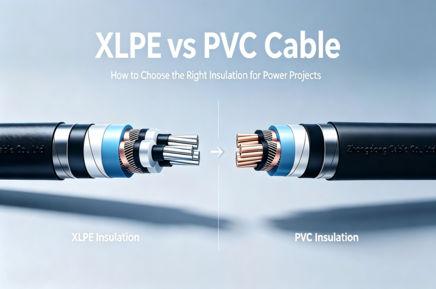 If you are specifying power cables for a project, the insulation type is one of the first decisions you will make. Two options dominate the market: XLPE and PVC. Both are widely used, but they are not interchangeable.
This guide compares XLPE and PVC across five practical dimensions—temperature, electrical performance, installation, service life, and cost. By the end, you should know which one fits your project.
Temperature is where XLPE and PVC diverge most clearly.
XLPE insulation typically supports conductor operating temperatures around 90°C, compared with approximately 70°C for PVC. That 20°C gap directly affects how much current a cable can safely carry.
Under the same installation conditions, XLPE generally offers higher current-carrying capacity. For projects with heavy loads or high ambient temperatures, XLPE provides useful operating margin.
PVC can still handle the same load, but often requires a larger conductor size to stay within its lower temperature limit. That upsize adds copper or aluminium cost—partially offsetting PVC's lower insulation price.
What this means in practice: If your project has high loads or warm site conditions, XLPE gives you more headroom. If you go with PVC, check whether you need to upsize the conductor—and factor that into your cost comparison.
The electrical properties of the insulation determine which voltage levels each material can serve.
XLPE offers low dielectric losses and high insulation resistance. That is why it dominates medium voltage applications—from 6kV up to 35kV and beyond. You will find XLPE in wind farm collector systems, solar plant cabling, industrial power transmission, and distribution networks.
PVC has higher dielectric losses and lower insulation resistance. It works well at low voltage—typically up to 1kV—but does not belong in medium voltage systems.
What this means in practice: If your system voltage is 6kV or above, the choice is already made. XLPE is the appropriate material. PVC is not a candidate in that range.
Installation conditions often drive the choice as much as electrical performance does.
XLPE has a stronger, more rigid molecular structure. It handles heat and environmental stress well, making it suitable for direct burial, long cable pulls, underground routes, and exposed outdoor runs. But it is less flexible during installation—bending radius is larger, and tight spaces are more difficult to navigate.
PVC is noticeably softer and more flexible. It bends more easily, threads through tight cable trays, and handles frequent changes in direction without issue. The trade-off: in cold environments, PVC becomes stiff and brittle. Below freezing, it requires pre-heating before installation.
What this means in practice: Tight spaces and frequent bends at normal temperatures? PVC has an edge. Direct burial, long routes, outdoor exposure, or cold climates? XLPE is the safer bet.
Replacing a cable is expensive. The job involves excavation, labour, and system downtime—costs that far exceed the cable itself. Insulation durability matters.
XLPE is cross-linked. That molecular structure resists thermal ageing and water tree growth, helping it maintain electrical and mechanical stability over decades of operation. Its typical design life extends well beyond that of PVC.
PVC ages differently. The plasticisers that keep it flexible can migrate out over time—especially under heat or moisture exposure. The material hardens, becomes brittle, and can crack. Under demanding conditions, PVC's service life is noticeably shorter.
What this means in practice: For permanent infrastructure expected to last 20 years or more, XLPE is the stronger long-term choice. For temporary installations or short project horizons, PVC is entirely adequate.
Cost is always a factor, but focusing only on the purchase price can be misleading.
PVC cables typically cost 15–25% less than XLPE of the same specification—a real difference, and on large projects, a visible one.
But that is not the full picture. Consider two additional factors:
Conductor size. If your load and site temperature require PVC to use a larger conductor than XLPE would need, the extra copper or aluminium cost eats into the insulation saving. In some cases, it eliminates it entirely.
Replacement. If PVC needs replacement sooner than XLPE—and it often does—the cost of that second installation (cable, labour, downtime) will likely exceed any savings on the initial purchase.
What this means in practice: For short-term projects, PVC's lower upfront cost is a real advantage. For long-term infrastructure, run a lifecycle cost calculation before assuming PVC is the cheaper option.
|
Application |
Recommended Choice |
Why |
|
35kV wind farm collector systems |
XLPE |
Voltage, temperature, and lifespan all point to XLPE |
|
Solar plant cabling |
XLPE |
Outdoor thermal performance matters |
|
Medium voltage distribution (6-35kV) |
XLPE |
Designed for higher electrical stress |
|
Permanent building power (≤1kV) |
Depends on lifespan and budget |
XLPE for long-term, PVC for cost-sensitive short-term |
|
Temporary construction power |
PVC |
Short duty cycle, low upfront cost |
|
Tight spaces or frequent bends |
PVC |
Better flexibility at normal temperatures |
|
Direct burial |
XLPE (often with armour) |
Better moisture and thermal ageing resistance |
|
Cold climates |
XLPE |
PVC stiffens and becomes brittle below freezing |
Before choosing between XLPE and PVC, ask yourself these four questions:
Q1: What is the system voltage?
*6kV or above → XLPE is the only practical choice.
*1kV or below → Continue to Q2.
Q2: What is the expected project lifespan?
*20 years or more → XLPE is usually the better long-term investment.
*Short-term (a few years) → Continue to Q3.
Q3: Is the site environment warm—ambient temperatures regularly approaching or exceeding 40°C?
*Yes → XLPE. PVC may require a larger conductor, eroding its cost advantage.
*No → Continue to Q4.
Q4: Is the cable route tight, with frequent bends and limited space?
*Yes, and site temperature stays above 0°C → PVC is a viable option.
*Direct burial or long straight pulls → XLPE is more suitable.
"PVC is cheaper, so we should use it whenever the budget is tight."
This statement is only half correct. What is true: the purchase order will show a lower number.
What is often missed:
* PVC's lower temperature rating may force a larger conductor size—and that adds copper or aluminium cost
* PVC's shorter service life means earlier replacement—and replacement costs (labour, excavation, downtime) usually far exceed the initial price difference
The right calculation is:
Lifecycle Cost = First Cost + Installation + Operating Losses + Replacement Cost
Run those numbers for your actual project before assuming PVC is the cheaper option. In many long-term projects, XLPE turns out to be the more economical choice over the full service life.
Zhongdong Cable has been manufacturing power cables for over 20 years, with production covering both XLPE and PVC insulated types across medium and low voltage ranges. Our products are designed and tested according to IEC 60502-2:2014 and GB/T 12706 standards.
Over years of supplying projects in China and export markets, we have noticed a recurring pattern: most selection disputes are not about the materials themselves. They come from not getting three basic parameters right at the planning stage—voltage, temperature, and lifespan. That is the gap this guide tries to fill. And whichever insulation type fits your project, we have the production capability to deliver it.
XLPE and PVC both have their place. Neither is universally "better." The right choice depends entirely on your project conditions.
Three parameters matter most: voltage, temperature, and service life.
Get those three numbers clear, and the decision becomes straightforward. Take those three numbers to your supplier—and ask for a lifecycle cost comparison, not just a price per metre.
A cable that fails early or cannot carry the load is never a bargain. A cable that costs a little more upfront and runs reliably for decades is almost always the better investment.
Standard references in this article: IEC 60502-2:2014 Power cables with extruded insulation and their accessories for rated voltages from 1kV (Um=1.2kV) up to 30kV (Um=36kV) – Part 2: Cables for rated voltages from 6kV (Um=7.2kV) up to 30kV (Um=36kV); GB/T 12706 Power cables with extruded insulation and their accessories for rated voltages from 1kV (Um=1.2kV) up to 35kV (Um=40.5kV)


 CU/XLPE/PVC Single Core Power Cable 0.6/1kV
Zhongdong Cable combines premium raw materials, large-scale manufacturing capabilities, and strict quality control systems to deliver cable products that fully match your technical requirements and brand identity.